
Diligence Yourself Before Investors Do: Questions That Determine Life Sciences Investability
By David H. Crean, Cardiff Insights (Cardiff Advisory LLC). Republished here with credit to the original source.
Founders spend a great deal of time preparing to diligence investors before asking for a check and inviting them to the cap table.
Who invests in our stage? Who understands our therapeutic area? Who has sufficient capital? Who can lead? Who can follow? Who has portfolio contacts?
All important questions. But there is another diligence process that should happen first.
Diligence yourself.
Before the first investor meeting, founders and CEOs should examine their company through the same lens an investor will use. Identify the weaknesses. Understand the unanswered questions. Know which risks can be mitigated, which can be explained, and which require more work before going to market for capital.
In life sciences, this matters even more than it does in many other industries. Experience tells me so.
Investors are not simply evaluating a product and projecting revenue growth. They are underwriting years of scientific, clinical, regulatory, manufacturing, reimbursement, financing, and execution risk. In many cases, they are being asked to invest long before meaningful revenue exists.
That makes investability a function of risk reduction.
Ready to get into it?
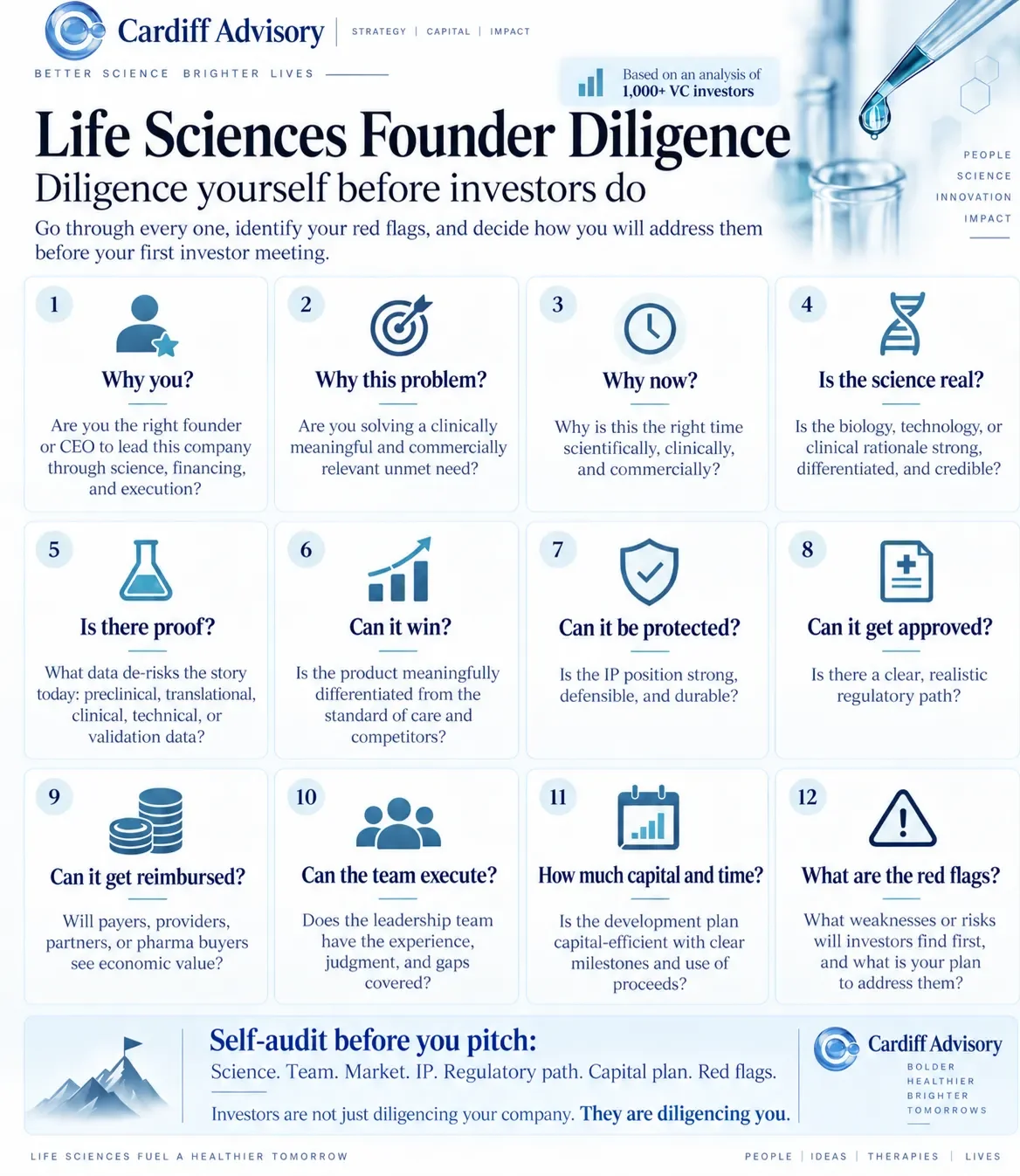
Based on the recurring diligence patterns seen across more than 1,000 venture investors, there are 12 major questions I believe every life sciences founder and CEO should be able to answer before beginning a serious fundraising process.
1. Why you?
This is more important than many founders realize.
Why are you the person to build this company?
Scientific credentials matter, but they are only part of the answer. Investors are assessing whether the founder or CEO can lead an organization through financing, clinical development, regulatory interactions, partnerships, setbacks, hiring decisions, board dynamics, and ultimately commercialization or an exit.
A brilliant scientist does not automatically become an effective CEO.
Likewise, an experienced executive without sufficient scientific fluency may struggle to establish credibility around a highly technical platform.
The real question is whether the leadership of the company fits the problem being solved and the stage of development.
Know your strengths. More importantly, know your gaps.
2. Why this problem?
A fascinating scientific problem is not necessarily an investable problem.
What unmet need are you actually addressing?
For therapeutics, investors will examine disease burden, treatment limitations, patient segmentation, competitive intensity, clinical endpoints, standard of care, and commercial opportunity.
For diagnostics, they will want to understand what clinical decision changes because your test exists.
For medical devices, the question becomes whether the technology solves a sufficiently important problem for physicians, hospitals, patients, and payers to change behavior.
The best companies are not built around technology looking for an application. They begin with a meaningful problem and demonstrate why their technology provides a compelling solution.
3. Why now?
Timing matters.
Why is this opportunity possible today when it was not five years ago?
Perhaps biology is better understood. Biomarkers have improved. Regulatory precedent has emerged. Manufacturing technology has matured. Clinical trial design has evolved. AI has made certain analyses possible. The competitive landscape has shifted. A major incumbent has validated the market.
Investors want to understand the catalyst.
“Why now?” is ultimately a question about whether scientific progress, market conditions, and company development have converged at the right moment.
4. Is the science real?
Every life sciences investment eventually comes back to this question.
Does the biology make sense?
Is the mechanism supported by credible evidence?
Is the technology reproducible?
Does the therapeutic hypothesis connect logically to the disease?
Are there independent publications supporting the underlying science?
Has the work been replicated outside the founder’s laboratory?
Investors know that early data can be compelling without being predictive.
The strongest companies do not simply show attractive results. They demonstrate a coherent chain of evidence connecting biological rationale to therapeutic or diagnostic effect.
5. Is there proof?
Science becomes more investable as uncertainty decreases.
What evidence exists today?
That may include:
Preclinical efficacy.
Translational biomarkers.
Toxicology.
Pharmacokinetics and pharmacodynamics.
Analytical validation.
Clinical validation.
Human proof of mechanism.
Early efficacy.
Manufacturing reproducibility.
The important distinction is between interesting evidence and evidence that changes the probability of success.
Investors will ask what has actually been de-risked.
Founders should ask the same question before investors do.
6. Can it win?
Being innovative is not enough.
Your product must ultimately compete against something.
That may be an approved therapy, another clinical-stage asset, an existing diagnostic workflow, a device, surgery, watchful waiting, or simply physician inertia.
Investors want to understand your future product profile.
Is it safer?
More effective?
Easier to administer?
Less expensive?
More durable?
More convenient?
Capable of treating patients current therapies cannot reach?
A company does not need to be first. But it needs a credible reason to win.
7. Can it be protected?
Strong science without defensibility can create value for everyone except the investors financing it.
Intellectual property diligence therefore goes well beyond asking whether patents have been filed.
Investors will want to understand composition-of-matter protection, method-of-use claims, freedom to operate, patent life, geographic coverage, licensing obligations, university rights, inventorship, competitive filings, and opportunities for additional protection.
For platform companies, the issue becomes even more important.
What exactly does the company own?
And what prevents a better-capitalized competitor from reproducing the opportunity?
8. Can it get approved?
Regulatory strategy should never be treated as something to figure out later.
What is the regulatory pathway?
What endpoints will regulators accept?
What patient population will you study?
What precedent exists?
What discussions have occurred with the FDA or other regulatory authorities?
Are there opportunities for Fast Track, Breakthrough Therapy, Orphan Drug, RMAT, 510(k), De Novo, PMA, or other relevant pathways?
A sophisticated investor is not simply asking whether approval is possible.
They are asking whether management understands the path well enough to estimate the time, capital, and development risk required to get there.
9. Can it get reimbursed, and at what price?
Approval does not automatically create a commercial product.
Someone ultimately has to pay.
Founders need to understand reimbursement earlier than they often do, particularly in diagnostics and medical devices.
Who is the economic buyer?
What is the reimbursement mechanism?
What evidence will payers require?
Does the product reduce downstream costs?
Does it improve outcomes enough to justify premium pricing?
Will adoption require changes in physician workflow?
In therapeutics, investors will also consider pricing, market access, competitive contracting, patient identification, treatment duration, and the potential response of payers as the market evolves.
Clinical value and economic value are related, but they are not identical.
10. Can the team execute?
Investors understand that early-stage companies will not have every executive position filled.
They do expect the founder to know what capabilities are missing.
Scientific development.
Clinical operations.
Regulatory affairs.
CMC.
Commercial strategy.
Finance.
Business development.
Fundraising.
Corporate governance.
A strong leadership team is not one where everyone has the same background. It is one where the collective capabilities match the company’s next several value-creating milestones.
The willingness of a founder to recruit people who know more than they do in critical areas is often a positive signal.
11. How much capital and time?
This is where scientific ambition meets financial reality.
What does the next financing actually accomplish?
Not “18 months of runway.”
What milestone does the capital reach?
IND?
First patient dosed?
Phase 1 readout?
Proof of concept?
Regulatory submission?
Commercial launch?
Partnering inflection point?
Every financing should have a destination.
Investors will also test your assumptions. Clinical timelines slip. Enrollment is slower than anticipated. Manufacturing costs increase. Regulatory agencies request additional studies.
A credible financing plan therefore includes contingency, not merely arithmetic.
The strongest capital plans connect dollars to milestones and milestones to increases in enterprise value.
12. What are the red flags?
This may be the most valuable question of all.
What will an investor discover?
A crowded competitive field?
Weak patent protection?
Founder concentration risk?
An incomplete management team?
A small addressable market?
Poor reproducibility?
CMC complexity?
A long regulatory path?
A difficult reimbursement environment?
Unrealistic valuation expectations?
A financing requirement larger than the current syndicate can support?
Every company has weaknesses.
Trying to hide them rarely works.
Sophisticated investors understand risk. What concerns them more is management that does not recognize risk.
A founder who can say, “Here is the issue, here is why it matters, and here is what we are doing about it,” demonstrates judgment.
That builds credibility.
The purpose of self-diligence
The objective is not to eliminate every risk before approaching investors.
That is impossible.
Life sciences investing is fundamentally about financing risk in pursuit of asymmetric value creation.
The objective is to understand your risks better than anyone else.
Before fundraising, put your company through its own investment committee.
Science. Team. Market. Intellectual property. Clinical strategy. Regulatory path. Reimbursement. Competition. Capital requirements. Execution.
Then ask the hardest question:
If I were the investor, what would stop me from writing the check?
Write down the answer.
Then decide what you can fix, what you can mitigate, and what you need to explain.
Because by the time you walk into the first investor meeting, the diligence process has already started.
Investors are diligencing the science.
They are diligencing the market.
They are diligencing the company.
And they are diligencing you.
Diligence yourself before investors do.
Disclosure
Cardiff Advisory LLC is an M&A investment banking, strategic advisory and valuation firm focused on the Life Sciences and Healthcare sectors. This article is provided for informational purposes only and does not constitute an offer, invitation, or recommendation to buy, sell, subscribe for or issue any securities.
The principals of Cardiff Advisory LLC are registered representatives of BA Securities, LLC Member FINRA SIPC, located at Four Tower Bridge, 200 Barr Harbor Drive, Suite 400 W. Conshohocken, PA 19428. Cardiff Advisory LLC and BA Securities, LLC are unaffiliated entities. All investment banking services and securities are offered through BA Securities, LLC, Member FINRA SIPC.
© 2026 Cardiff Advisory LLC.
