
2026 Life Science Lab Fit-Out Costs: What Tenants Need to Know
Building out life science lab space is a significant capital investment, and the cost can vary dramatically depending on the type of laboratory, infrastructure requirements, and market.
According to Cushman & Wakefield’s 2026 U.S. Life Sciences Fit-out Cost Guide, average fit-out costs across nine lab and space types range from $179 per square foot (PSF) for warehouse space to $1,376/PSF for gene and cell therapy manufacturing. Across six major U.S. life science markets, market-level blended averages range from approximately $594 to $907/PSF.
For life science companies evaluating new lab space, however, the headline PSF number tells only part of the story. The type of science being performed, the proportion of specialized lab and manufacturing space, mechanical and utility requirements, and local construction market can all have a significant impact on the final project budget.
What Goes Into a Life Science Lab Fit-Out Cost?
A life science fit-out cost is a composite of 10 trade categories:
Miscellaneous architectural trades
Architectural millwork
Doors, frames, and hardware
Drywall, acoustics, and carpentry
General finishes
Special construction, including cleanrooms and cold rooms
Mechanical, plumbing, and fire protection
Electrical
General conditions and fee
Contingency
The figures in Cushman & Wakefield’s Guide assume construction begins from a cold shell, with base-building utilities and floor loading already sized for life science use and the core-and-shell scope in place.
Importantly, the figures exclude process and lab equipment, soft costs such as architecture, engineering, and permitting, low-voltage cabling, audiovisual systems, security systems, and furniture. In other words, actual all-in project costs can be higher than the fit-out figures alone suggest.
One category dominates nearly every project: mechanical, plumbing, and fire protection account for approximately 35% of total fit-out spending, on average across markets and space types. General conditions and fees and electrical work each account for approximately 12%, while miscellaneous architectural trades represent roughly 10%.
That cost distribution reflects the infrastructure required by life science space including dedicated air handling, standby power, specialized gas and utility distribution, and cleanroom-grade finishes. Much of what makes a laboratory expensive is behind the walls and above the ceiling rather than immediately visible within the finished space.
2026 Life Science Fit-Out Costs by Lab Type
The nine space types tracked by Cushman & Wakefield span roughly an eightfold cost range from the least to most expensive, driven primarily by mechanical/HVAC and containment requirements.

Gene and cell therapy manufacturing tops the list because of the specialized infrastructure it requires, including ISO 7/8-classified HVAC, fabricated panel partitions, seamless floors, passthrough autoclaves, ISO 5 isolators, dedicated cold-room storage, and cGMP power and utility redundancy.
Warehouse space requires comparatively little: dehumidification control, sealed concrete flooring, in-rack sprinklers, and tall single-story clearances. As a result, its average fit-out cost is roughly one-eighth that of a cGMP gene or cell therapy suite.
2026 Life Science Fit-Out Costs by U.S. Market
Geography also has a substantial impact on lab construction costs. Among the six markets analyzed, San Francisco is the most expensive market to build in, while Raleigh-Durham is the most economical.
The table below includes the Guide’s headline averages where provided, along with a simple, unweighted average across all nine 2026 lab-type totals calculated from the Guide’s detailed market tables.
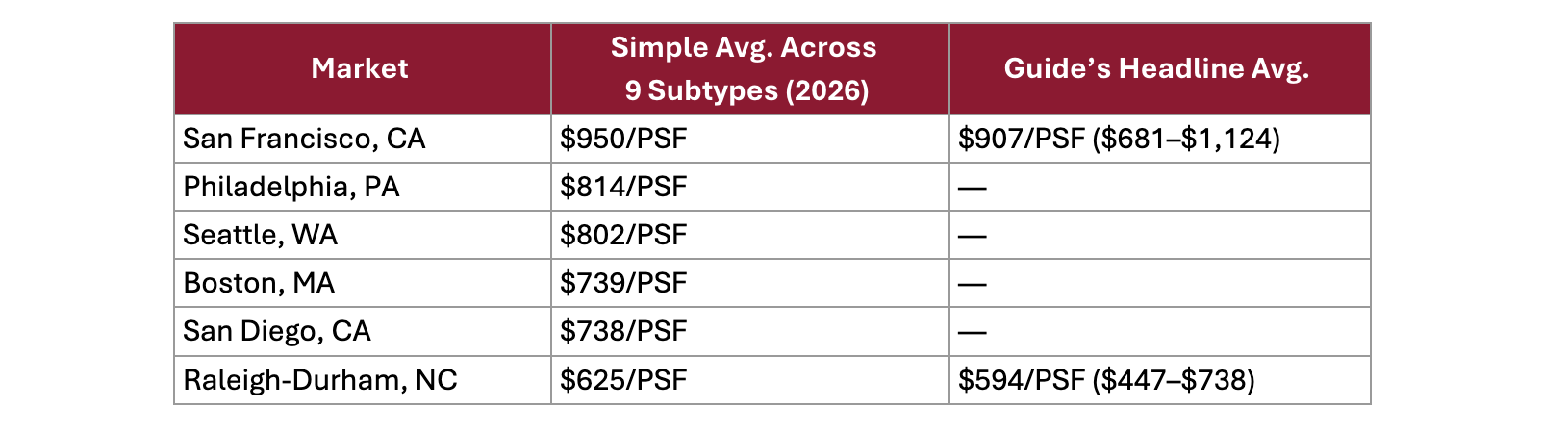
The single most expensive fit-out in the dataset is gene/cell therapy and cGMP bulk manufacturing space in San Francisco, at $2,120/PSF, followed by the same space types in Philadelphia at $1,812/PSF.
At the other end of the spectrum, warehouse space is cheapest in Raleigh-Durham, with costs as low as $86/PSF, and Boston and San Diego close behind at approximately $101/PSF.
For Bay Area life science companies, the San Francisco numbers underscore the importance of understanding build-out requirements early in the site-selection process. A space with attractive lease economics may carry a very different overall occupancy cost once the infrastructure required for a company’s specific laboratory use is considered.
What Does a Life Science Fit-Out Cost on an Actual Project?
Per-square-foot benchmarks are useful for comparing space types, but actual laboratory projects typically include a mix of expensive technical space and lower-cost office, warehouse, circulation, and support areas.
Cushman & Wakefield illustrates this with a sample small cGMP gene therapy manufacturing facility in Seattle. The project starts from a cold shell and includes a gene manufacturing suite, QA/QC analytical lab, BSL-2 lab space, cGMP warehouse, and standard office and support areas.
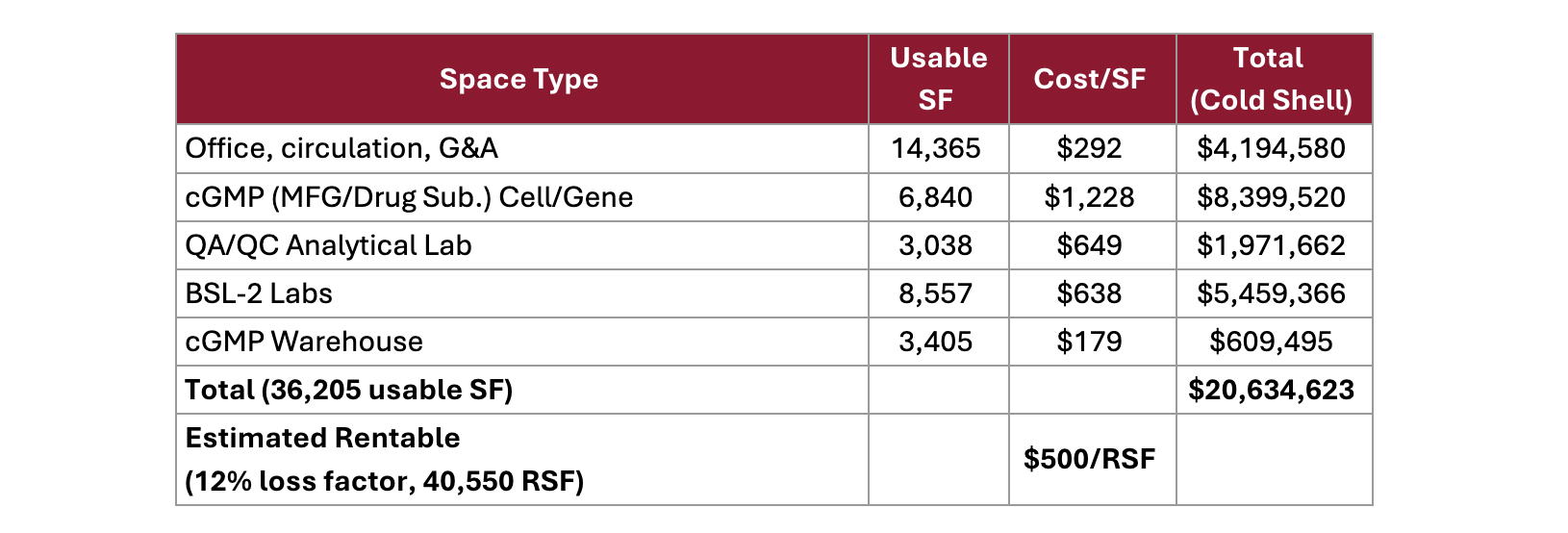
The blended cost of $500/RSF falls well below the per-square-foot figure for any single high-cost space type within the project.
That distinction is important for life science tenants planning a build-out: overall project economics depend heavily on the ratio of expensive laboratory and manufacturing space to lower-cost office and support space, not simply the presence of a premium laboratory use.
What Is Driving Life Science Construction Costs in 2026?
The Guide’s 2026 figures reflect a construction market facing competing cost pressures.
Labor Costs Remain a Major Pressure
Overall construction costs rose 3.4% year over year as of November 2025, with common labor costs up 4%, a five-year high, and skilled labor up 5.7%. Immigration enforcement is adding to workforce constraints. Roughly 30% of the U.S. construction workforce is foreign-born, exceeding 60% in some trades, and a recent Associated General Contractors of America survey found that 28% of contractors had already been affected by enforcement actions.
Tariffs Are Adding Pressure to Material Costs
Materials pricing increased 2% year over year as suppliers began passing through tariff-related costs they had initially absorbed. Cushman & Wakefield estimates tariffs could ultimately add another 4.4% to 4.8% to overall construction costs.Fit-Out Pricing Has Still Softened
Despite those pressures, life science fit-out pricing softened slightly in 2026, declining 2.7% year over year to an average of $741/PSF. Life science construction activity has slowed sharply, with space under construction down 48% year over year and at approximately one-quarter of its 2023 peak. That slowdown has pushed general contractors to bid more competitively for a thinner pipeline of work, while previously lower fuel costs eased energy-related expenses has now reversed and will contribute to future increases.
Elevated Vacancy Is Creating a Different Construction Environment
National life science vacancy remains elevated at 24.7%, nearly triple early-2021 levels. New York has the highest vacancy at 40.4%, while Orange County at 1.9% and Philadelphia at 7.9% are the tightest markets included in the data.
At the same time, leasing activity is showing signs of recovery. New leasing activity is up 31% on a four-quarter rolling basis since early 2024. While activity remains below the 2021–2022 peaks, it suggests that some accumulated vacancy is beginning to be absorbed.
Labspace Directory’s tracking of the Bay Area’s sub-10,000-square-foot market has also found the small-space segment to be substantially more occupied than the broader Bay Area life science market.
For early-stage and growing companies searching for smaller laboratory footprints, that distinction matters: headline vacancy figures for an entire market may not accurately reflect the availability of appropriately sized lab space.
What Life Science Tenants Should Consider When Budgeting a 2026 Lab Build-Out
For companies budgeting a laboratory project in 2026, today’s somewhat softer fit-out pricing may represent a temporary window created by weaker construction demand and competitive general contractor bidding, rather than evidence that the underlying pressures from labor scarcity, tariffs, workforce constraints, and energy costs are going away.
Locking in pricing and project scope while contractors remain hungry for work may therefore be more advantageous than assuming further cost reductions are ahead.
More broadly, the data reinforces why life science companies should evaluate real estate cost and build-out cost together. Base rent is only one component of the economics of occupying laboratory space. Existing infrastructure, the required lab configuration, the mix of technical and support areas, and the amount of work needed before occupancy can materially change the true cost of one location relative to another.
For companies evaluating lab space, understanding those requirements early can help create more realistic budgets, improve comparisons between properties, and reduce the risk of selecting a seemingly attractive space that requires significantly more capital or time to become operational.
Source: Cushman & Wakefield Project & Development Services, “2026 U.S. Life Sciences Fit-out Cost Guide,” developed in partnership with The Richmond Group, Shawmut, and Commodore.