
Laboratory Contamination: 7 Common Sources, Risks, and Prevention Strategies
Contamination is one of the most pervasive threats to the reliability, reproducibility, and regulatory integrity of life science laboratory operations. While specific risks vary across research, clinical, pharmaceutical, biotechnology, and biosafety-level (BSL) laboratories, contamination generally occurs when unwanted biological, chemical, particulate, environmental, or informational material enters a laboratory, sample, process, or analytical system.
For laboratory scientists and operators, contamination is much more than a housekeeping issue. It can alter cellular behavior, compromise assay performance, produce false-positive or false-negative results, invalidate experiments, damage instrumentation, result in the loss of irreplaceable samples, and potentially trigger significant regulatory or quality-system consequences.
Understanding where contamination comes from - and how laboratory design, operations, maintenance, and personnel practices can help control it - is an important part of protecting both scientific integrity and laboratory operations.
-
Biological contamination is among the most common and consequential forms of laboratory contamination. It can compromise experiments, alter biological systems, generate unreliable data, and result in significant losses of research time and materials.
Common biological contaminants include:
Bacteria
Fungi, including mold and yeast
Viruses
Mycoplasma
Endotoxins
Contaminating or misidentified cell lines
The highest-risk environments generally include cell culture, tissue culture, and molecular biology laboratories, where biological systems and sterile workflows create particularly significant consequences when contamination occurs.
Mycoplasma: A Particularly Significant Threat
Mycoplasma warrants special attention in cell culture laboratories because it can remain essentially invisible during routine microscopic examination. Published studies have reported substantial levels of mycoplasma contamination among cell cultures, with estimates varying considerably by laboratory population and detection methodology.
Mycoplasma can alter cellular metabolism, modify gene expression, affect cell growth and viability, change experimental phenotypes, interfere with molecular and biochemical assays, and remain undetected for extended periods.
As a result, a contaminated culture can produce apparently credible experimental results while fundamentally altering the underlying biology. Routine mycoplasma surveillance is therefore an important component of cell-culture quality control.
-
Personnel are one of the most significant sources of laboratory contamination. Human-derived contaminants can include skin flakes, hair, respiratory droplets, clothing fibers, cosmetics, sweat, and microorganisms carried on the body or clothing.
Risk increases when personnel handle sterile materials incorrectly, reuse or improperly change gloves, touch sterile pipettes or containers, enter controlled environments without appropriate gowning, talk or cough over exposed sterile materials, or move unnecessarily between clean and contaminated work areas.
Personnel contamination is particularly important in cleanrooms, cell culture facilities, clinical laboratories, and other controlled environments.
Effective controls include appropriate gowning, hand hygiene, glove discipline, controlled access, aseptic technique, personnel training, and minimizing unnecessary movement and activity around exposed materials.
-
Air is a major pathway for the movement of both particulate and biological contaminants.
Airborne contaminants can include dust, fibers, pollen, mold and fungal spores, microorganisms, and construction debris. Potential sources include HVAC deficiencies, damaged or contaminated ceiling systems, open windows or doors, construction activity, excessive foot traffic, and inadequate filtration or maintenance.
HEPA filtration can substantially reduce airborne particulate and microbial contamination, but it does not eliminate contamination risk. Facility design, pressure relationships, filtration maintenance, airflow management, cleaning, and personnel practices remain critical.
Construction and renovation deserve particular attention. Demolition, drilling, ceiling access, and the movement of construction personnel can release large quantities of previously settled particulate material. Where laboratories remain operational adjacent to construction, appropriate containment and environmental controls are essential.
-
Cross-contamination occurs when material from one sample, culture, reaction, or process is unintentionally introduced into another. It can be particularly consequential in molecular biology and analytical laboratories.
Common sources include DNA carryover during PCR, aerosolized droplets, cell-line cross-contamination, shared pipettes or equipment, shared stock solutions, repeated use of common reagents, and improper workflow separation.
Potential consequences include false-positive PCR results, invalid sequencing data, incorrect cell-line identification, compromised assay results, and erroneous scientific conclusions.
A fundamental control is the physical and procedural separation of incompatible workflows. For example, pre-PCR activities should be appropriately segregated from post-PCR activities because amplified nucleic acid can represent an exceptionally high contamination burden.
-
Chemical contaminants may be invisible and may not produce an obvious laboratory event. Nevertheless, even trace quantities can interfere with sensitive biological and analytical processes.
Potential contaminants include cleaning-agent residues, disinfectants, solvents, heavy metals, plasticizers, detergents, and degraded chemicals or laboratory plastics.
Sources can include inadequate rinsing, improper chemical storage, degraded materials, spills, and inappropriate cleaning procedures.
Chemical contamination may alter cell viability, enzyme activity, analytical measurements, chromatography, spectroscopy, and other experimental endpoints. Because many chemical contaminants cannot be identified visually, appropriate material selection, chemical compatibility, cleaning validation, and procedural controls are important.
-
Purified water is a critical laboratory input, and its required quality varies depending on its intended use. Potential contaminants include bacteria, endotoxins, biofilms, minerals, dissolved organic carbon, metals, and other ionic or particulate impurities.
Water-system contamination can cause cell toxicity, failed assays, poor chromatography, analytical variability, and instrument damage. Sources may include deteriorating purification systems, inadequate sanitization, stagnant distribution loops, contaminated storage vessels, and maintenance failures.
Water quality should therefore be matched to its intended laboratory use, with appropriate monitoring, maintenance, sanitization, and replacement of filtration or purification components.
-
Laboratory equipment can serve as both a source and a reservoir of contamination.
Frequently affected equipment includes biosafety cabinets, incubators, centrifuges, pipettes, water baths, microscopes, refrigerators and freezers, and other laboratory instrumentation.
Contamination can result from inadequate cleaning, condensation, biofilm formation, contaminated filters, spills, improper maintenance, or inappropriate use.
Incubators are particularly vulnerable because warm, humid conditions can support microbial growth. Water reservoirs, door seals, internal surfaces, and condensation points require particular attention.
Equipment contamination can also become persistent because a contaminated instrument may repeatedly expose successive samples to the same contaminant. Preventive maintenance, validated cleaning and decontamination procedures, appropriate monitoring, and documented service histories are therefore essential.
-
Contamination risk extends beyond what happens directly at the bench. Building systems, reagents, utilities, and even information-management processes can affect the integrity of laboratory operations.
Facility and Environmental Contamination
Contamination can originate outside the laboratory itself through roof or plumbing leaks, mold within walls or building systems, HVAC contamination, ceiling dust, construction and renovation, or pest infestations.Facility-related contamination is particularly serious because a single building-system failure can affect multiple laboratories simultaneously. Water intrusion and construction activity should therefore be treated as potential contamination events rather than simply facility-maintenance issues.
Reagent Contamination
Reagents and media can become contaminated through improper handling, storage, or repeated use. Examples include expired media, contaminated buffers, shared stock solutions, improperly stored reagents, and materials subjected to inappropriate freeze-thaw cycles.Commercially manufactured reagents are not inherently immune from contamination once they enter laboratory use. Good reagent management requires appropriate storage, labeling, handling, expiration control, and segregation where necessary.
Utility-System Contamination
Laboratories depend on critical utilities such as compressed air, nitrogen, carbon dioxide, vacuum, steam, and purified water.Filtration failures, inadequate maintenance, leaks, or contamination within distribution systems can introduce contaminants into multiple laboratory processes simultaneously. Utility-system failures therefore have the potential for broad operational impact.
Information and Data Contamination
Not all contamination is physical. Sample identity and data integrity can also be compromised through sample mislabeling, barcode errors, chain-of-custody failures, data mix-ups, and incorrect instrument or software configurations.These events can invalidate otherwise technically sound laboratory work. Strong sample-identification systems, electronic records, validated software, instrument controls, and documented chain-of-custody procedures are therefore integral components of contamination control.
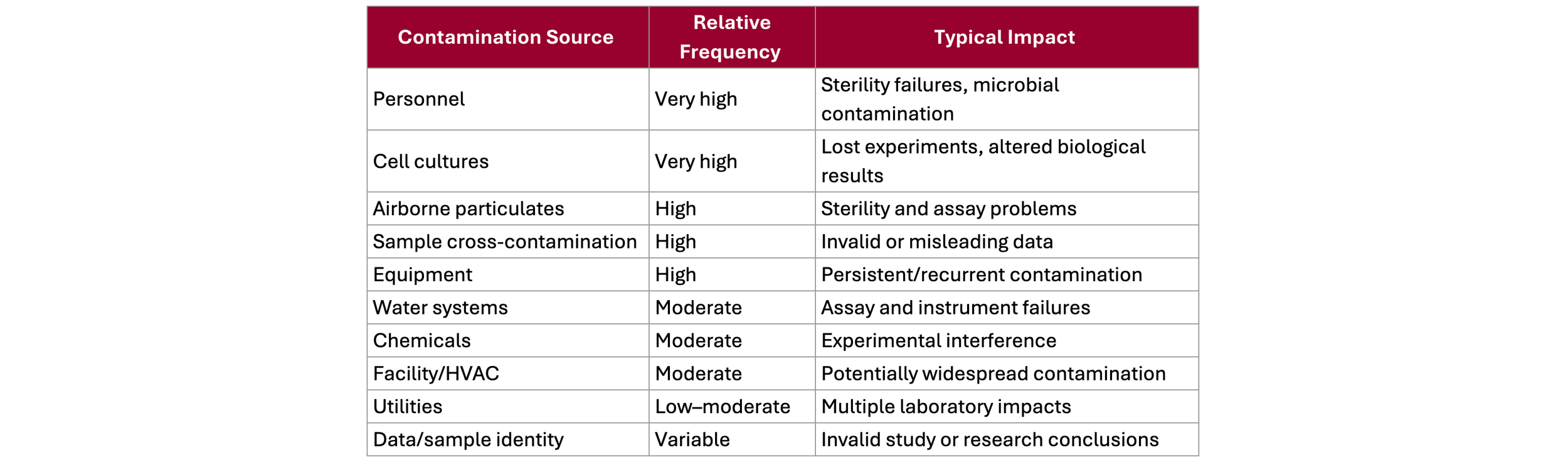
Understanding Relative Contamination Risk
The frequency and potential impact of contamination varies significantly depending on its source:
Laboratory Contamination Control Requires a Systems Approach
Effective contamination control requires more than routine cleaning. It is a risk-based laboratory management system that incorporates facility design, personnel practices, equipment maintenance, environmental monitoring, workflow controls, and quality assurance.
Core controls include:
Aseptic technique and personnel training appropriate to the laboratory’s activities.
Validated cleaning and disinfection procedures, including appropriate disinfectant selection and contact times.
Preventive maintenance of biosafety cabinets, HVAC systems, incubators, water systems, and critical laboratory equipment.
Environmental monitoring of air, surfaces, water, and other relevant media based on laboratory risk.
Routine mycoplasma testing where cell culture is performed.
Workflow segregation, particularly for activities such as pre- and post-PCR processing.
Controlled access, gowning, PPE, and personnel-flow procedures appropriate to the laboratory classification.
Validated sterilization and decontamination processes for critical equipment and materials.
Reagent and sample controls, including appropriate labeling, storage, segregation, and traceability.
Incident investigation and corrective and preventive action (CAPA) when contamination is detected.
For laboratories operating under GMP, GLP, or other regulated quality systems, contamination control is also a regulatory and quality expectation. Laboratories must be able to demonstrate that environmental conditions, equipment, processes, and personnel practices are suitable for their intended use and that contamination events are detected, investigated, documented, and appropriately corrected.
Protecting the Integrity of the Lab and the Science
Laboratory contamination is best understood as a multifactorial systems risk, not simply a microbiological problem. Biological agents, personnel, airborne particles, samples, chemicals, water, equipment, building systems, utilities, reagents, and information-management processes can each compromise laboratory operations.
The most effective contamination-control programs identify potential contamination pathways before an event occurs, establish controls proportional to the laboratory’s risk profile, continuously monitor critical conditions, and systematically investigate deviations when they occur.
Ultimately, contamination control serves a straightforward objective: protecting the integrity of the sample, the validity of the experiment, the reliability of the data, and the scientific conclusions that depend on them.